What Dental Procedures Are Covered Under Group OPD Plans in India?
for hr team
What Dental Procedures Are Covered Under Group OPD Plans in India?
Dr. Manoj Rajan
8 min
read
Last Reviewed:
May 2026
Share
short answer
Group OPD dental plans in India typically cover preventive care (cleanings, scaling, X-rays), restorative procedures (fillings, root canals, extractions, pediatric dentistry) and prosthetic procedures like crowns and bridges on the base or premium plan. Implants, orthodontics, cosmetic procedures and elective aesthetic dentistry are usually structured as optional riders. Specific coverage, sub-limits and waiting periods vary across plan tiers, but the underlying coverage logic is consistent across well-designed Indian dental plans.
For HR leaders evaluating dental coverage for their workforce, the most useful question isn't "do we have dental in our policy" - it's "which procedures will our employees actually be able to claim, and which will they be told are excluded after the fact." This article walks through the procedure-by-procedure coverage structure that defines well-designed Indian group OPD dental plans in 2026.
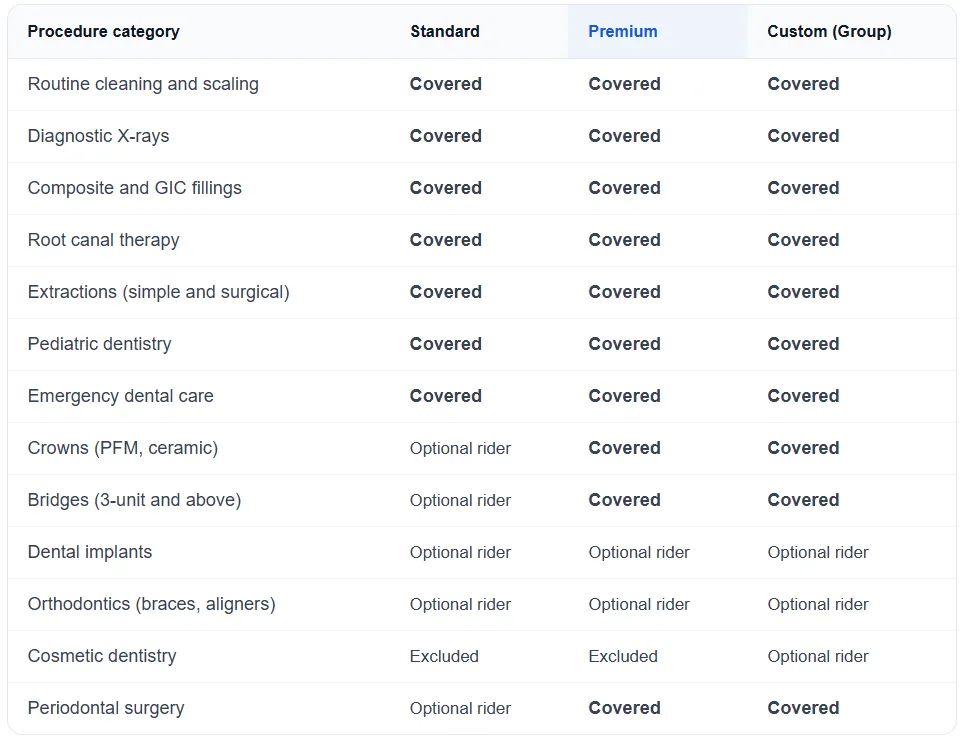
The full coverage list at a glance
*The coverage logic in this article reflects how ToothLens Dental Plans are structured, drawn from operating a network of 1,500+ dental clinics across India. Specific tier coverage, sub-limits and rider availability vary by plan; the underlying clinical and actuarial reasoning is consistent.
The structure across tiers reflects three principles: preventive care is always covered (employers benefit financially from preventive utilisation), high-frequency restorative care is always covered (this is what employees actually use), and high-cost discretionary or elective procedures sit as optional riders so the base plan stays affordable.
Preventive Care: What's Covered and Why
Preventive dental care is the most heavily covered category in any well-designed group OPD plan, and there's a specific clinical reason. Preventive dental visits don’t necessarily reduce total spend immediately - but they significantly reduce subsequent nonpreventive dental visits and lower nonpreventive dental expenditures, making dental spend more predictable over time. An employer who covers preventive care fully spends less in aggregate on dental than an employer who excludes it - counterintuitive but consistently true in deployment data.
What's typically covered in the preventive category:
Routine professional cleaning (scaling and polishing) - covered twice a year on most plans, with the second visit at 6-month intervals from the first.
Diagnostic radiographs - intra-oral X-rays and panoramic X-rays as needed for diagnosis.
Comprehensive dental examinations - initial and recall examinations.
Topical fluoride treatments - covered on most plans, particularly those with significant pediatric coverage.
Dental sealants for children - covered on plans with pediatric inclusion.
What employees should expect: cashless settlement at network clinics for all preventive procedures, with no deductible on most well-structured plans. Pre-authorisation is typically straightforward for preventive care because the clinical evidence requirements are minimal.
Restorative Procedures: What's Covered and Why
Restorative dentistry, fixing teeth that have decay, fracture or other damage, is the highest-frequency claim category after preventive care. Coverage is broad on the base tier of most plans because excluding restorative care defeats the purpose of having dental cover at all.
Covered procedures in this category:
Composite (tooth-coloured) fillings - covered on most plans. Some older plan structures cover only amalgam fillings on the base tier, but this is increasingly rare in current Indian plan design.
Glass ionomer cement (GIC) fillings - covered on virtually all plans.
Root canal therapy (single-rooted and multi-rooted) - covered on most plans, with clinical pre-authorisation required because root canal procedures have moderate per-claim cost and specific evidence requirements (radiograph showing the indication).
Extractions - both simple and surgical extractions covered. Surgical extractions (impacted teeth, bony impactions) typically require pre-authorisation with radiograph evidence.
Pulp therapy - covered as an extension of root canal coverage.
The clinical pre-authorisation requirement on procedures like root canals exists for a specific reason. Root canal claims are frequently submitted in error (a procedure billed as a root canal when only pulp therapy was performed, or vice versa). Pre-authorisation with radiograph evidence catches the discrepancy before payment. On Toothlens-administered plans, AI-driven pre-authorisation completes this review in under 4 hours for routine cases.
Prosthetic Procedures: Coverage Logic for Crowns and Bridges
Crowns and bridges represent a step up in cost and complexity. Plan design here splits into two patterns:
On standard tiers - Crowns and bridges are often structured as optional riders, not because they aren’t clinically important (they are, especially after root canal treatment), but because their relatively high per-claim cost (₹3,000–25,000+ depending on material, higher for bridges) and classification as major restorative procedures create meaningful cost impact at a population level.
On premium tiers - crowns and bridges are included in the base coverage, often with sub-limits per claim and per policy year.
What employees should know: a crown placed after a root canal is functionally part of the same treatment plan, but is billed as a separate procedure. A plan that covers root canals but excludes crowns leaves the employee with the more expensive part of the treatment uncovered. Premium-tier coverage or a crown rider closes this gap.
Material choices matter for coverage eligibility. Porcelain-fused-to-metal (PFM) crowns are the standard covered option on most plans. All-ceramic and zirconia crowns may be covered at PFM rates with the difference paid by the employee, or covered fully on premium tiers.
Implants and Orthodontics: Why these sit as Optional Riders
Two procedure categories are consistently structured as optional riders rather than base coverage on Indian dental plans, and the reasoning is structural:
Dental implants are high per-procedure cost (₹25,000–60,000 per implant including crown), often elective or partially elective, and asymmetric across employee populations. An employee with a single missing tooth has a fundamentally different claim profile from a population average. Indemnity pricing on a base plan including implants becomes uncompetitive; structuring implants as a rider keeps base premiums accessible while making implant cover available to employees who specifically need or want it.
Orthodontics (braces, clear aligners) is similarly structured because of two characteristics: utilisation skews heavily toward children and young adults, and treatment plans extend across 18–36 months rather than being completed in single visits. This makes traditional claim-by-claim adjudication poorly suited; orthodontic riders typically use lump-sum or staged-payment models instead.
Cosmetic dentistry (veneers, whitening, smile design) is generally excluded from base coverage and from most riders because the procedures are by definition elective. Some custom group plans include cosmetic procedures as a rider option, but this is uncommon.
Pediatric Dentistry and Emergency Dental Care
Two categories that are universally covered but sometimes overlooked when employees evaluate plans:
Pediatric dentistry is covered on most family-inclusive plans. This typically includes preventive care, restorations, pulp therapy on primary teeth, and space maintainers. Plans that include children in coverage should specify the age cut-off (typically 18 or 21).
Emergency dental care like toothache, dental trauma, abscesses requiring urgent treatment, etc. is covered on most plans without the standard pre-authorisation timeline. Cashless settlement is available at network clinics for emergencies. Out-of-network emergency care is typically reimbursable, with documentation requirements.
What's Typically not Covered, and Why
Three categories sit outside coverage on most Indian group OPD dental plans:
Pre-existing conditions during the waiting period - most plans waive waiting periods on Day 1 cashless coverage (particularly true on Toothlens-administered plans), but plans with traditional waiting periods may exclude pre-existing conditions for the first 30–90 days.
Cosmetic procedures with no medical indication - purely aesthetic procedures.
Treatments arising from self-inflicted injury or substance use - standard insurance exclusions apply.
Coverage outside the network clinic i.e. when an employee chooses to receive treatment at a non-network clinic, is typically reimbursable on most plans, but at the network rate rather than the actual cost paid. Cashless settlement requires using a network clinic.
How to Evaluate the Right Dental Plan
Choosing the right dental plan comes down to asking a few critical questions:
When does coverage actually begin? Are there waiting periods on routine procedures, or is care accessible from Day 1?
What is truly covered vs. capped? Especially for restorative treatments like crowns, root canals, and extractions.
How are high-cost procedures structured? Are they included, limited, or offered as riders?
Will employees actually use it? Or does plan design create friction at the point of care?
The third question - access - matters in particular. Plans with 30-90 day waiting periods on routine procedures effectively delay care, even when coverage exists on paper. In contrast, plans that enable Day 1 access tend to see higher utilization of preventive and early-stage treatments.
A well-structured plan brings these elements together, ensuring immediate access for high-frequency procedures, meaningful coverage for restorative care, and controlled exposure on high-cost treatments through sub-limits or riders. The goal is not just coverage breadth, but real usability without creating cost volatility at a population level.
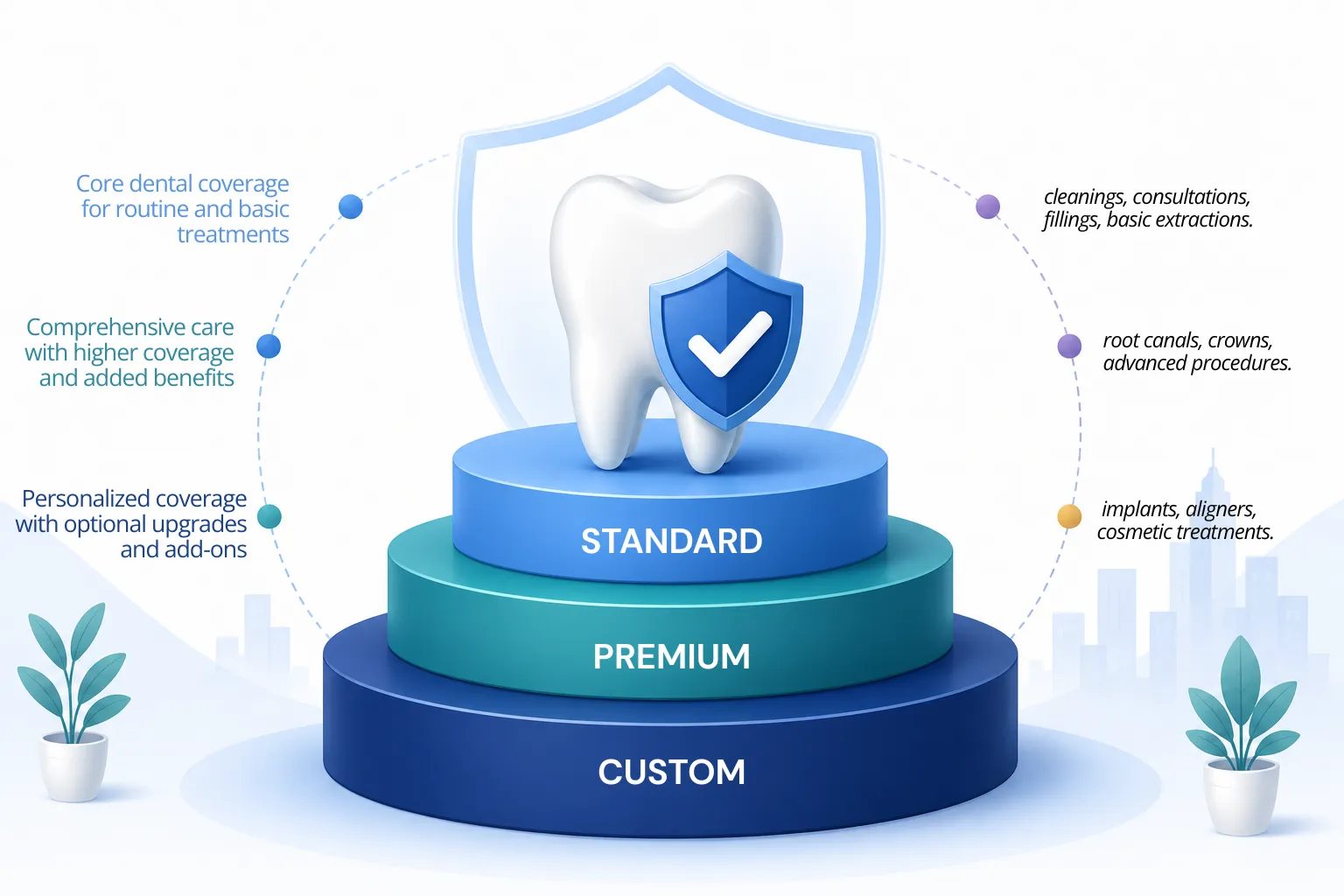
It’s also worth noting that tier structures like Standard / Premium / Custom Group are broadly representative, but not universal. Different insurers may use varying tier names, inclusion lists, and sub-limit structures - making it important to evaluate the underlying design rather than relying on labels alone.
Toothlens Dental Plans are designed with this balance in mind - offering Day 1 cashless access for standard procedures, while applying longer waiting periods only to select high-cost treatments like implants. If you’re rethinking how dental benefits can drive both utilization and cost efficiency, happy to share how this can be structured for your team.
Dr. Manoj Rajan
Founder, ToothLens. Dentist (BDS) and dental services operator with experience across India and the GCC. Founded ToothLens to make preventive dental care accessible and affordable through insurance.
Are you rethinking how dental benefits can be introduced for your team while ensuring strong utilization and cost efficiency?
Toothlens Dental Plans are designed with this balance in mind - offering Day 1 cashless access for standard procedures, while applying longer waiting periods only to select high-cost treatments like implants.


.svg)