short answer
Group OPD dental plans in India typically cover preventive care (cleanings, scaling, X-rays), restorative procedures (fillings, root canals, extractions, pediatric dentistry) and prosthetic procedures like crowns and bridges on the base or premium plan. Implants, orthodontics, cosmetic procedures and elective aesthetic dentistry are usually structured as optional riders. Specific coverage, sub-limits and waiting periods vary across plan tiers, but the underlying coverage logic is consistent across well-designed Indian dental plans.
Two brokers pitch the same group health plan to the same employer. Same insurer, same sum insured, near enough the same premium. One holds the renewal for three years. The other loses it in year two.
The difference is rarely the policy. It is what happens after the policy is signed.
That is the part of breaking AI that is quietly rewriting. Most of the industry conversation is still about distribution: leads, quotes, faster onboarding. The more interesting shift is downstream, in claims, where brokers earn or lose their accounts.
Distribution: the same job with better instruments
Start with the part everyone talks about.
Metro corporate accounts are contested and well served. The growth sits with smaller employers in smaller cities, where a high-touch sales cycle is hard to justify on commission alone. That is a maths problem, and AI chips away at it in unglamorous ways.
Underwriting models trained on claims data let insurers price a small group without weeks of back-and-forth. Outreach tooling lets a two-person broking team run a nurture program that once needed an agency. Quote comparison stops eating a full day per account.
EY makes a similar case for the Indian insurance market, identifying micro-agents, digital platforms and AI/ML-led underwriting as important levers for expanding insurance access, particularly in underserved regions. EY also highlights the role of digital transformation, richer data sources and InsurTech partnerships in making underwriting and insurance operations more efficient and affordable.
None of this closes a deal. It changes how many real conversations you get into in a quarter.
The bigger problem sits after the sale
Now the number is worth carrying into your next renewal meeting.
Grievances in India's general and health insurance segment rose 41 percent in FY25, to 137,361 from 97,503 the year before, according to IRDAI's annual report. Nearly seven in ten of those complaints concerned claim refusal, delays in settlement, partial payments, and disputes over documentation.
The friction is not at the point of sale. It is in claims.
And brokers absorb it. When an employee's claim is short-settled, HR does not call the insurer. HR calls you. Servicing load is what caps how many accounts one broker can genuinely hold, and a bad claims year puts a renewal at risk even when the pricing was sharp.
Which reframes what AI is for. Selling more policies is the easy half. Reducing friction after the sale is where the harder value sits.
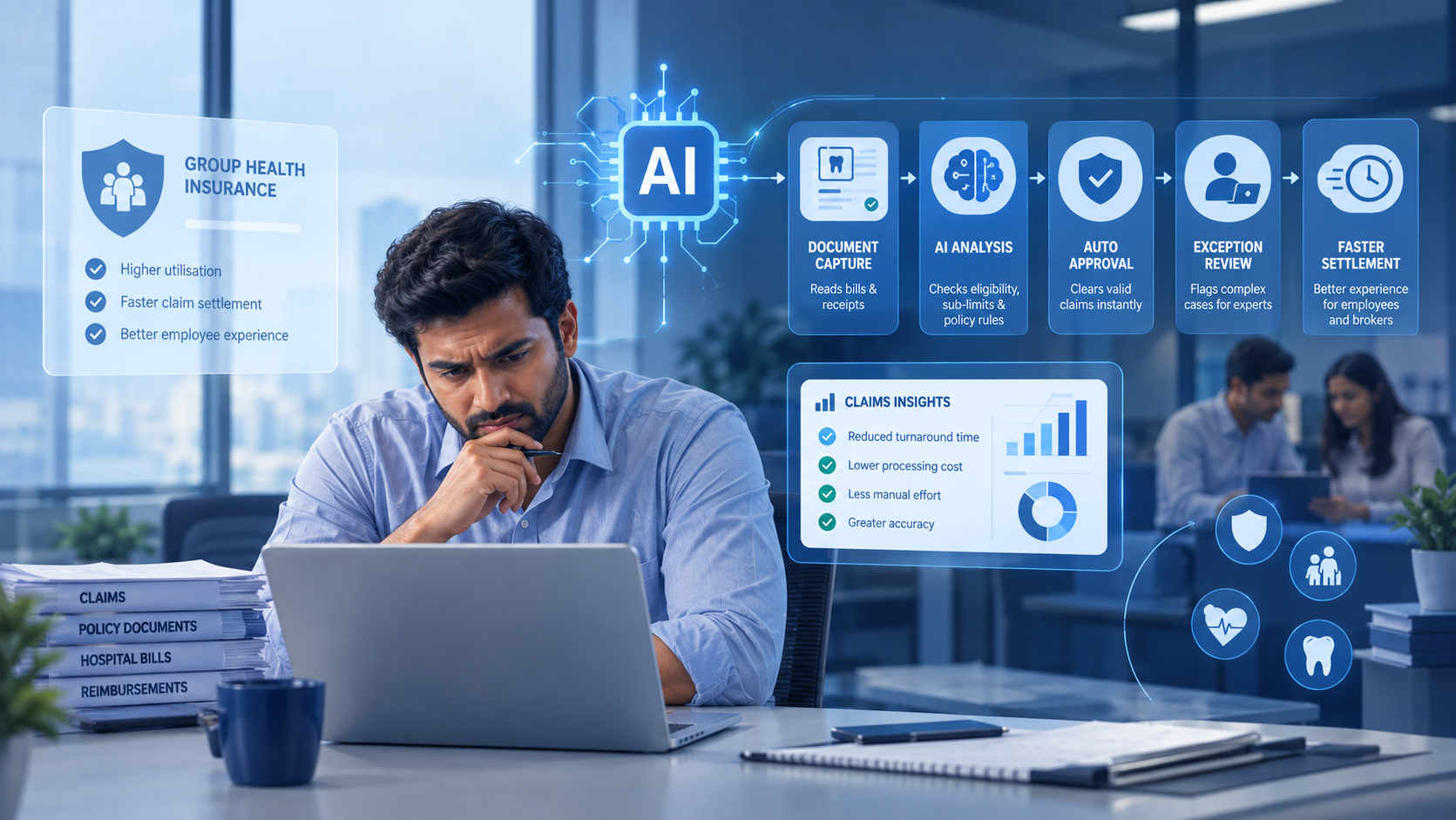
AI vs manual claims adjudication
Manual adjudication carries a roughly fixed cost per claim. A reviewer opens the file, checks the policy, reads the bills, applies sub-limits and passes a decision. That effort is broadly similar whether the claim is large or small.
For hospitalization, the math works. The claim value dwarfs the processing cost. For outpatient care, it gets difficult. OPD claims are small, frequent and document heavy: a consultation receipt, a pharmacy bill, a diagnostic report, sometimes a photograph. When processing costs eat a real share of the claim value, the benefit is hard to offer at scale. That helps explain why OPD and dental cover in India tends to be thin, tightly capped, or quietly left out.
Automated adjudication changes the arithmetic. Document capture reads the bill. Rules engines apply eligibility and sub-limits. Where the benefit involves clinical evidence, image models can assess it. Clean claims are clear without a human touching them, so reviewers only see real exceptions. Decisions get more consistent across similar claims, each with an audit trail behind it.
For a broker, that is not a technology feature. It is the ability to put an OPD or dental benefit into a proposal and defend the service promise behind it.
Where the human still decides
Worth being honest about the limits. An automated rejection with no explanation is worse than a slow one. A model that drifts can build a pattern of denials nobody notices until the ombudsman does. And the accountability still lands on a person, whoever the decision came from.
The industry knows trust is the hard part. KPMG's research found that 46 percent of insurance leaders have reservations about whether AI can be trusted, while only 25 percent fully trust AI within their organizations. The same research found that 82 percent recognize the importance of robust frameworks, policies, and processes for regulatory compliance and responsible AI implementation.
So the broker's value moves rather than disappears. The questions become sharper: What share of claims is decided without human review? What is the appeal route? Can the insurer produce a reason code for every rejection? What is the measured turnaround time, not the brochure turnaround time?
The point isn't to slow AI down. It's to make sure that when AI makes insurance faster, someone can still explain, challenge, and take responsibility for the decision.
What this looks like in practice
Dental is the clearest test of all this, because it is the benefit manual processing has most reliably priced out of the Indian group plan. Employees ask for it. Most brokers still cannot offer it, and not for lack of demand. There is no dental network to plug into, no ready plan designs, and no claims infrastructure to sit behind them.
That is the gap ToothLens closes, and AI is what makes the economics work rather than the headline. SmartCheck assesses oral health at enrollment, so risk is understood before the policy goes live instead of being discovered at the claim stage. OlivePro validates claims before settlement, clearing clean ones without manual intervention and routing the rest to a reviewer.
Around that sits the part brokers actually sell on: a Pan-India cashless network, ready Group, Flex and Super Top-Up structures, co-branded member portals, and utilization dashboards you can put in front of an HR head at renewal. You add a revenue line without building dental infrastructure yourself. Your client gets a benefit employees use.


.svg)